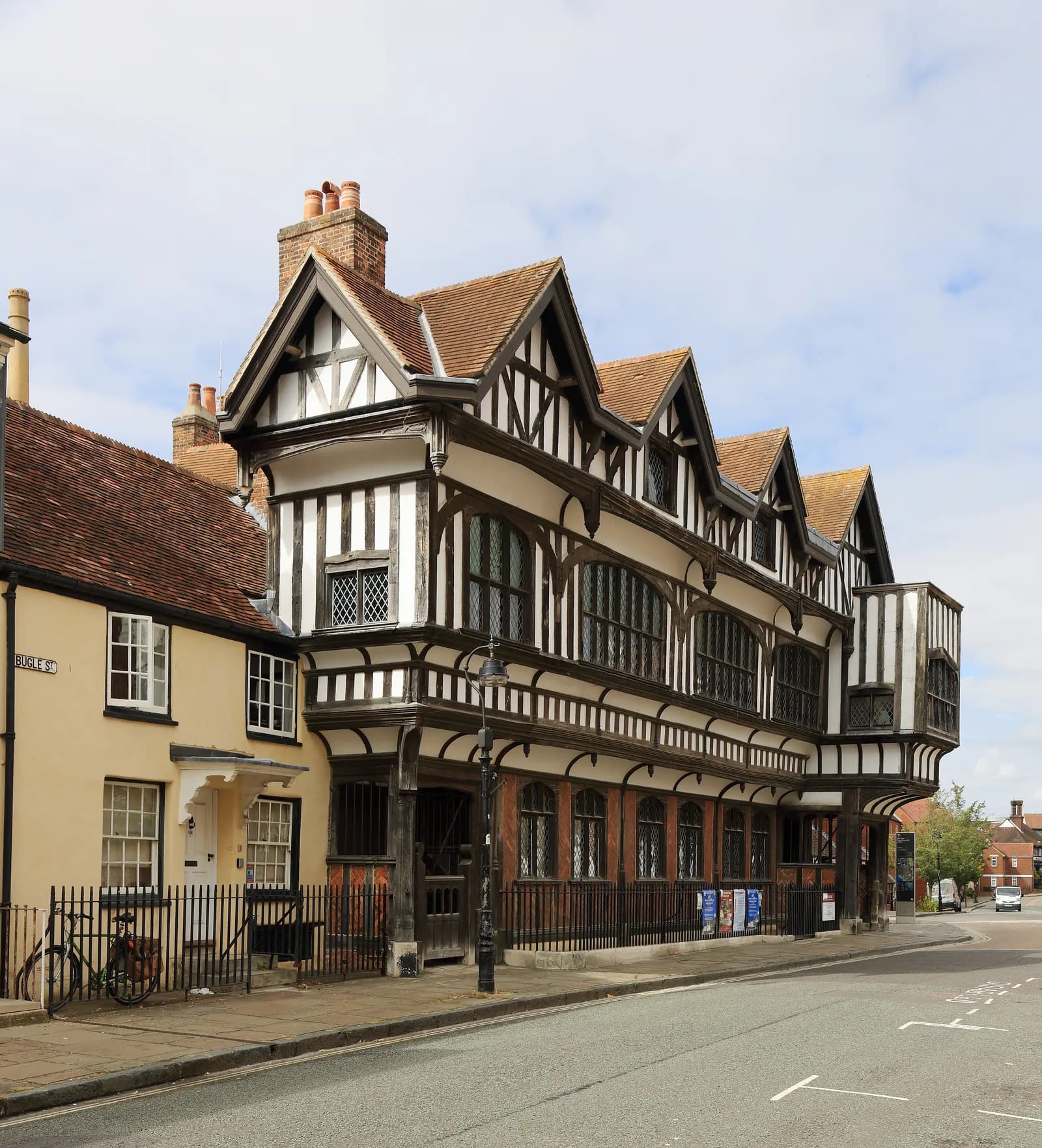
Tudor House and Garden stands as Southampton's most significant historic building, with origins stretching back to the 1180s. The Grade I listed structure on Bugle Street preserves over eight centuries of history within its walls, from Norman domestic architecture to a Victorian museum that continues to welcome visitors today.
From Norman Palace to Tudor Mansion
The oldest section of the building dates to the 1180s, constructed as King John's Palace, one of the finest surviving examples of Norman domestic architecture in England. Built by an unknown owner, this stone structure served as a residence for wealthy merchants importing French wine. The ground floor stored wine casks while the first floor provided spacious living quarters with large windows and a fireplace.
The palace gained its royal association when King John visited Southampton in the early 1200s. John Whytegod, a merchant who served as mayor of Southampton in the 1300s, owned the property during this period. Blue Anchor Lane, which runs beside the house, was formerly known as "Wytegod's Lane" in recognition of this connection.
Following the French raid on Southampton in 1338, the town strengthened its defences. The palace was modified to become part of the town wall, with windows filled with stone or converted to gun slits. Archaeological evidence from this period remains visible in the building's fabric today.
Sir John Dawtrey and the Tudor Transformation
The structure acquired its familiar name and appearance between 1491 and 1518 under Sir John Dawtrey. A major landowner, Member of Parliament, and Sheriff, Dawtrey received substantial sums from Henry VIII to supply food for the navy, including provisions for the Mary Rose. In 1491, he married Jane William, widow of Watkin William, and proceeded to join three existing cottages together to create the residence now known as Tudor House.
Dawtrey added the distinctive black and white timber façade to display his wealth and status. The house features panelled oak ceilings concealed beneath later plasterwork, herringbone brickwork beneath the render, and preserved Tudor beams. Southampton was one of only eight ports granted export status in the 1400s, and the wool and wine trade brought considerable prosperity to merchants like Dawtrey.
Upon Dawtrey's death in 1518, the house passed to Sir Richard Lyster, one of Southampton's wealthiest residents. Lyster served as Chief Justice of the King's Bench and employed eight servants. He decorated the house with extravagant tapestries and hosted lavish gatherings in the oak-panelled Banqueting Hall.
Decline and Rescue
The property entered a period of decline during the 19th century. By the 1830s, the house had been divided into several dwellings and businesses. George Pope operated a dyeworks on the ground floor from 1834 to 1888. The St Michael's area suffered a cholera epidemic in 1849 that claimed 240 lives, and by 1850 the district was described as "unfit for human habitation." The house was scheduled for demolition.
Wealthy Victorian philanthropist William Francis Gummer Spranger purchased the property in 1886 for £1,450, saving it from destruction. Spranger invested £7,000 in renovations, adding a minstrel's gallery he described as a "pure flight of romantic fancy." He also installed various decorative features, some authentic and some imaginative reconstructions.
Spranger offered the house to Southampton Corporation in 1905 for £4,200, but the offer was declined. When rumours circulated that an American buyer intended to transport the building to the United States, the Corporation reconsidered and purchased the property in 1910. The museum officially opened on 29 July 1912, making it Southampton's oldest museum.
The 21st Century Restoration
By 1999, a survey revealed major structural problems. The house was described as "opening like the petals of a flower" due to movement in the walls. The museum closed in 2002 for extensive restoration work.
Archaeological fieldwork conducted during the nine-year closure uncovered significant evidence about the building's history. Workers discovered maritime graffiti dating from 1570 to 1620 on the walls, depicting ships, caricatures, and exotic animals. The house served as an air raid shelter during the Southampton Blitz of 1940, with curator Edward Judd and his family sheltering in the wine cellar.
Following a £5.3 million restoration, the museum reopened on 28 July 2011. The work preserved the building's historical features while adding modern facilities including interactive displays and accessibility improvements.
The House Today
Visitors can explore multiple rooms representing different historical periods. The Banqueting Hall contains oak panelling and an audiovisual presentation about the house's history. The Georgian Room, added by artist George Rogers in the 18th century, features tall sash windows. The Rich Room served as the master bedroom, with servants' access to the attic. The Workroom preserves George Pope's dyeworks, while the Tudor and Victorian kitchens display period food and equipment with authentic herb and spice aromas.
The Trade Room illustrates Southampton's maritime importance through displays of weights, measures, and ship models. The attic contains a sedan chair and penny farthing. An air raid shelter in the basement features a light and sound show recreating the World War II experience, though it remains closed due to damp issues.
The Tudor Knot Garden
Behind the house lies a recreated Tudor knot garden designed by garden historian Dr Sylvia Landsberg in the early 1980s. The design draws from manuscripts and historical documents to represent how the garden might have appeared in the 1500s when John Dawtrey owned the property. The garden contains over 100 plants, mostly herbs and edible varieties that would have been grown for cooking and medicine.
Features include parapets and mounts, a fountain plot, a seat arbour, and a bee bole where straw skeps were kept for honey production. Ornaments represent former owners: a unicorn for John Dawtrey and a stag for Richard Lyster. An early 19th-century cannon, placed in the garden in the 1970s following the Itchen Bridge construction, adds a maritime element. St Michael's Church spire is visible beyond the garden walls.
Visiting Information
Tudor House and Garden operates under Southampton City Council's Museums and Gallery service. The museum opens Monday to Thursday from 10am to 3pm, Saturday and Sunday from 10am to 5pm, and remains closed on Fridays. Tickets can be booked through the Southampton Museums and Gallery website. A café serves locally produced food and beverages, and the museum shop offers related merchandise.
The house remains a focal point for understanding Southampton's development from a medieval port to a modern city. Its survival through periods of prosperity, decline, and wartime destruction makes it an essential site for anyone seeking to understand the city's layered history.