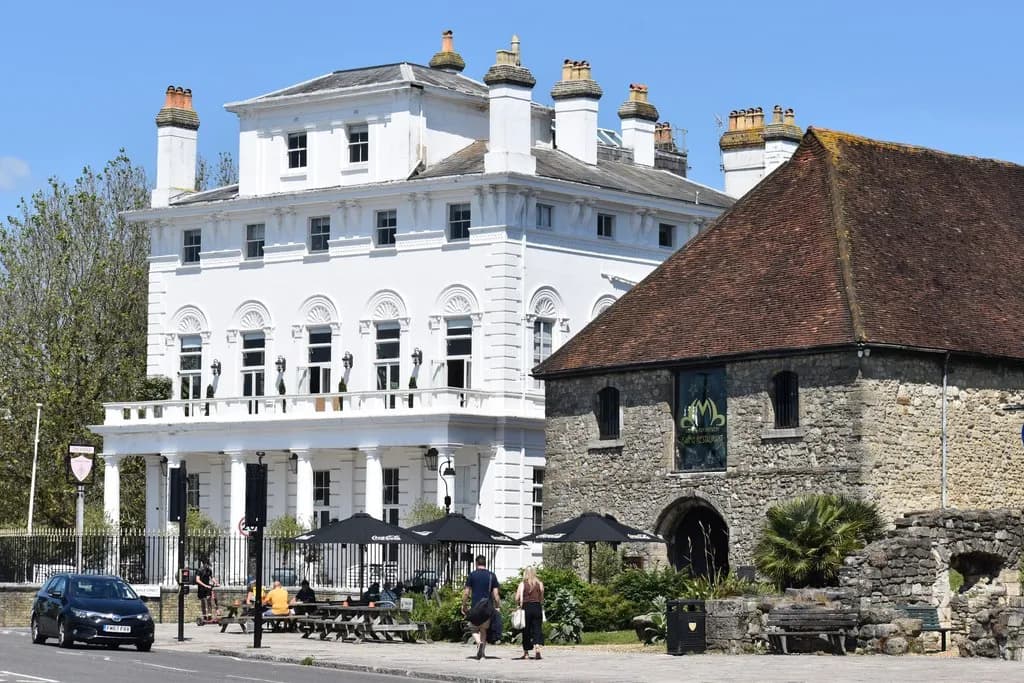
Standing on Bugle Street in Southampton's Old Town, The Wool House has witnessed nearly six centuries of the city's history. Built in 1417 by Cistercian monks as a warehouse for the medieval wool trade, this Grade I listed building has served as a prison for French captives, an aviation pioneer' s workshop, a maritime museum, and, since 2015, a popular brewpub.
Medieval Wool Trade Origins
The Wool House emerged from Southampton's position as a major medieval port. Constructed after the devastating French raid of 1338, the building stored wool bound for the galleys and carracks of Venice and Genoa. The wool trade formed the basis of Southampton's prosperity during the Middle Ages, with Italian merchants establishing a permanent presence in the town.
Built of stone rubble with angle quoins and topped with an old tiled roof, The Wool House represents the only surviving freestanding medieval warehouse in Southampton. Its most striking architectural feature is the fine 14th-century arched collar-braced roof, constructed from Spanish chestnut timber that has supported the structure for over 600 years. Three massive semi-circular buttresses on the west side, probably added during the 16th and 17th centuries, lend the building its distinctive silhouette.
A Prison for French Captives
The building's role shifted dramatically during the 18th and early 19th centuries when it became a prison for French prisoners of war. During the Seven Years War and the Napoleonic Wars, captured French sailors and soldiers were held within its thick stone walls.
These prisoners left tangible marks on the building. Their names remain carved into the roof beams, and graffiti dating from 1711 still survives on the interior stonework. These inscriptions provide a direct physical connection to the men who passed through the building during one of British history's longest military conflicts.
Birthplace of Southampton Aviation
The early 20th century brought another unexpected chapter. The Moonbeam Engineering Company Limited occupied the premises, initially building motor launches and selling wrought iron propellers and marine engines for export worldwide.
More significantly, the company provided workshop space for Edwin Moon, an aviation pioneer who would help establish Southampton's reputation in flight. Between 1909 and 1910, Moon constructed aircraft of his own design in a corner of The Wool House. His first aircraft, Moonbeam I, underwent testing in the Fawley area. His second design, Moonbeam II, was a monoplane weighing 260 lbs powered by a 20 horsepower J.A.P. engine.
Moon achieved Southampton's first successful powered flight between 12 April and 11 June 1910, taking off from fields at North Stoneham farm. That site later became Southampton International Airport, connecting The Wool House directly to the city's ongoing aviation heritage that would eventually include Supermarine and the Spitfire.
Maritime Museum Era
Following restoration by Southampton City Corporation, The Wool House reopened in June 1966 as the Southampton Maritime Museum. For nearly five decades, the building housed collections documenting the city's maritime heritage, ocean liner history, and connections to RMS Titanic. The museum attracted generations of visitors until its relocation to the SeaCity Museum in January 2012.
A New Chapter as Brewpub
After a brief period as a pop-up arts venue operated by Element Arts in 2013, The Wool House underwent its most recent transformation. In 2014, plans were approved for the Dancing Man Brewery to convert the historic building into a microbrewery and pub. The proposal generated controversy, with over 240 people signing a petition to retain the space as a community arts centre.
Despite objections, The Wool House reopened on 27 February 2015 as a brewpub and restaurant. The co-owners committed to preserving the building's historical fabric, including the French prisoners' graffiti, and planned historical exhibitions to maintain connections to the site's past.
Heritage Significance
Listed at Grade I on 14 July 1953 and scheduled as an ancient monument, The Wool House carries English Heritage Legacy ID 135747. Beyond its architectural merit, the building serves as a physical timeline of Southampton's development, from medieval commerce through military conflict, industrial innovation, and modern leisure.
The Wool House stands as proof that historic buildings can adapt to changing times while retaining their essential character. Visitors today can drink craft beer beneath the same Spanish chestnut beams that once stored wool for Italian merchants, housed Napoleonic prisoners, and sheltered aviation pioneers.