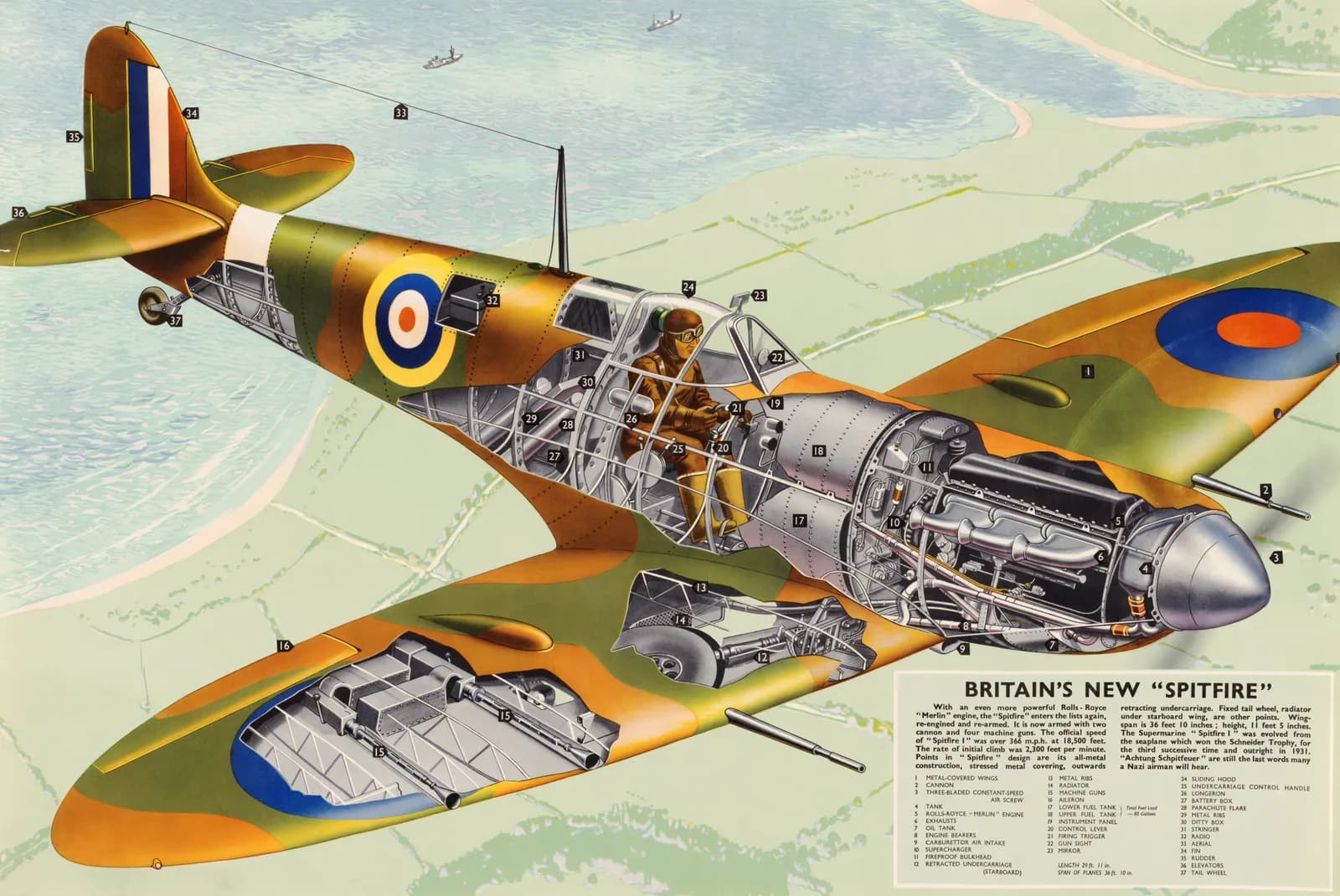
Reginald Joseph Mitchell never lived to see his creation enter combat, yet the aircraft he designed at Supermarine's Woolston works would become synonymous with British resilience during the Second World War. Mitchell, Southampton's most celebrated engineer, transformed from a locomotive works apprentice into the architect of the Spitfire, developing an aircraft that would see more than 20,000 examples built and remain in production until 1948.
From Staffordshire to Southampton
Mitchell was born on 20 May 1895 in Butt Lane, Staffordshire, the son of a headmaster. After attending Hanley High School, he began an engineering apprenticeship at Kerr Stuart & Co. locomotive works whilst studying at night school. In 1916, aged 21, he joined Supermarine Aviation Works at Woolston on the River Itchen in Southampton.
His rise was swift. Mitchell became assistant to owner Hubert Scott-Paine in 1917, works manager's assistant in 1918, and was promoted to chief designer in 1919 at the age of 24. By 1920 he was chief engineer, and in 1927 he became technical director. During his tenure he would design 24 aircraft, though it was his final design that would secure his place in history.
Racing Seaplanes and the Schneider Trophy
Mitchell's path to the Spitfire ran through the Schneider Trophy seaplane competitions of the 1920s and early 1930s. These international races for seaplanes provided both the technical challenge and the aerodynamic knowledge that would inform his later fighter designs.
His first success came in 1922 with the Sea Lion II, a modified Sea King that won the Schneider Trophy at Naples with an average speed of 145.7 mph. After the Sea Lion III competed in 1923, Mitchell moved to monoplane designs. The S.4 in 1925 crashed during trials, but the S.5 won the 1927 contest at Venice, securing first and second places for Britain. Mitchell was awarded the Royal Aeronautical Society's silver medal that same year.
The S.6 won the 1929 competition at Calshot, achieving an average speed of 328.64 mph. The definitive S.6B, funded partly by a £100,000 donation from Lady Houston after government support was withdrawn, won the 1931 Schneider Trophy outright for Britain. Flown by Flight Lieutenant George Stainforth, an S.6B broke the world air speed record on 29 September 1931, reaching 407.5 mph.
Designing the Spitfire
The Air Ministry's F7/30 specification of 1934 called for a new fighter aircraft. Mitchell's initial submission, the Type 224, featured an open cockpit, gull wings, and fixed undercarriage. It first flew in February 1934 but was rejected in favour of the Gloster Gladiator.
Undeterred, Mitchell began work on the Type 300 whilst the Type 224 was still being built. This was a radical departure: a monoplane with enclosed cockpit, retractable undercarriage, and the distinctive elliptical wing designed by Beverley Shenstone. The wing's thin cross-section allowed maximum speed whilst providing space for the undercarriage and guns.
The Air Ministry issued contract AM 361140/34 on 1 December 1934, providing £10,000 for a prototype. The aircraft, serial K5054, first flew from Eastleigh Aerodrome (now Southampton Airport) on 5 March 1936, piloted by Joseph "Mutt" Summers. The test pilot's reported comment upon landing, "don't touch anything," indicated the design's soundness.
The Air Ministry ordered 310 Spitfires on 3 June 1936 at a cost of £1,395,000. First production aircraft K9787 rolled off the Woolston assembly line in mid-1938 and first flew on 15 May 1938.
Illness and Legacy
Mitchell was diagnosed with rectal cancer in 1933 and underwent surgery. He obtained his pilot's licence in 1934 but was forced to give up work in early 1937 when the cancer returned. He died at his Southampton home on 11 June 1937, aged 42, and was succeeded as chief designer by Joseph Smith.
Mitchell had been appointed CBE on 29 December 1931 for his services to the Schneider Trophy. He was survived by his wife Florence, an infant school headmistress whom he had married in 1918, and their child.
Southampton's Spitfire Heritage
The Spitfire entered RAF service on 4 August 1938. During the Battle of Britain in summer 1940, Spitfires operated alongside Hawker Hurricanes, typically engaging Luftwaffe fighters whilst the Hurricanes tackled bombers. The Woolston works on the River Itchen was heavily bombed on 26 September 1940, killing 92 people. Production was subsequently dispersed to sites in Reading, Salisbury, and Trowbridge.
More than 20,351 Spitfires were built in total, with 12,129 manufactured at Castle Bromwich from June 1940. The aircraft served in numerous variants, from the Merlin-powered Mk I to the Griffon-engined Mk 24, and in carrier-based Seafire configuration from 1942 until the mid-1950s.
Remembering Mitchell in Southampton
Solent Sky museum, located on Albert Road South, houses the R.J. Mitchell Memorial Museum. Opened on 26 May 1984, the museum displays Supermarine S.6A N248 (which competed in the 1929 Schneider Trophy) and Spitfire F.24 PK683, alongside Rolls-Royce Merlin engines and other aviation artefacts. The S.6B that won the 1931 Schneider Trophy is displayed at the Science Museum in London.
Eastleigh Aerodrome, now Southampton Airport, marks the site where Mitchell's most famous creation first took to the air on that March morning in 1936. Approximately 60 Spitfires remain airworthy today, with five forming part of the Battle of Britain Memorial Flight.