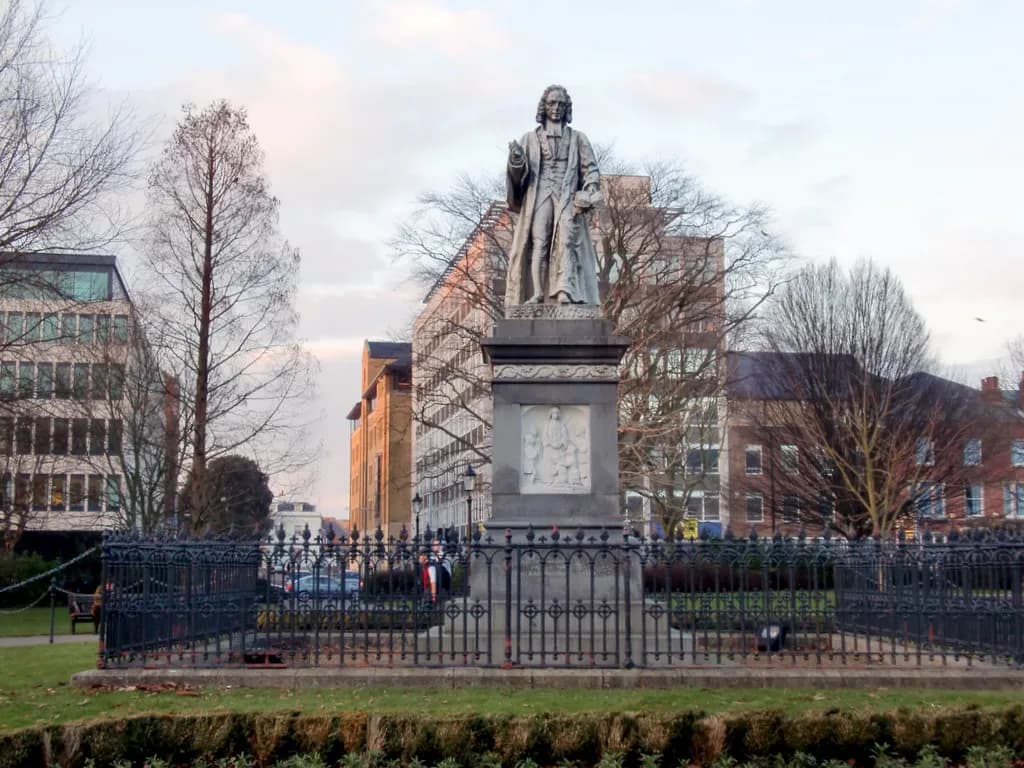
Isaac Watts was born in Southampton in 1674 and grew up to become one of the most influential hymn writers in the English-speaking world. Three centuries later, his hymns remain fixtures in churches across the globe, and his name endures in the city through statues, parks, and even the chimes of the Civic Centre clock tower.
A Nonconformist Upbringing
Watts was born on 17 July 1674 to Isaac Watts senior, a committed religious nonconformist who was twice imprisoned for his beliefs. Growing up in a household where faith carried serious consequences, the young Watts received a rigorous classical education at King Edward VI School in Southampton. There he learned Latin, Greek, and Hebrew, though his family's religious convictions barred him from attending Oxford or Cambridge, which at that time were restricted to Anglicans.
His precocious talent appeared early. According to tradition, when young Isaac was scolded for keeping his eyes open during prayers, he reportedly replied: "A little mouse for want of stairs / ran up a rope to say its prayers." After receiving corporal punishment for this irreverence, he is said to have cried: "O father, father, pity take / And I will no more verses make."
Transforming English Hymnody
In 1690, aged sixteen, Watts left Southampton to study at the Dissenting Academy in Stoke Newington. He would spend the rest of his life in that corner of north London, eventually living for thirty-six years with the Abney family at Abney House. Yet his Southampton roots remained significant throughout his career.
Watts is widely credited as the "Godfather of English Hymnody" for fundamentally changing how English-speaking churches sang. Before his influence, congregations sang only metrical psalms. Watts argued for "original songs of Christian experience" and produced some 750 hymns that brought personal faith into corporate worship.
His most enduring works include "Joy to the World," based on Psalm 98; "When I Survey the Wondrous Cross"; "Jesus Shall Reign Where'er the Sun"; and perhaps most famously, "Our God, Our Help in Ages Past," a metrical version of Psalm 90. These hymns appear in hymnals across denominations, from the Church of England's Hymns Ancient and Modern to the Baptist Hymnal and the Methodist Hymns and Psalms.
Southampton's Tribute
Watts died on 25 November 1748 and was buried at Bunhill Fields in London, where his chest tomb remains a Grade I listed monument. Yet Southampton has not forgotten its native son.
Watts Park, also known as West Park in the city's Central Parks, features a Carrara marble statue of the hymn writer mounted on a Rubislaw granite plinth. Erected in 1861 and facing the Civic Centre, the statue received renewed attention in 1985 when its inscription was recut. The park itself holds Grade II* listed status.
Perhaps most distinctively, the Southampton Civic Centre clock tower chimes the tune of "Our God, Our Help in Ages Past" three times daily: at 8:00, 12:00, and 16:00. The sound carries across the city centre as a regular reminder of Watts's enduring legacy.
Educational and Intellectual Legacy
King Edward VI School, Watts's alma mater, maintains his memory through a house named in his honour and through its school hymn: "Our God, Our Help in Ages Past." The connection between city and schoolboy-turned-hymn-writer remains tangible.
Beyond hymnody, Watts was a significant intellectual figure. His logic textbook, "Logick, or The Right Use of Reason in the Enquiry After Truth," published in 1724, became a standard text at Oxford, Cambridge, Harvard, and Yale for more than a century. His 1741 work "The Improvement of the Mind" later inspired the scientist Michael Faraday. He also wrote "Divine Songs Attempted in Easy Language for the Use of Children" in 1715, which included moral verses that influenced children's literature.
Global Reach, Local Roots
Watts's hymns have been translated into numerous languages and continue to be sung in churches worldwide, some three centuries after they were written. While memorials to him stand in Westminster Abbey and Abney Park Cemetery in London, his Southampton origins remain central to his story.
The Isaac Watts Memorial United Reformed Church in Southampton stands on the site of the former Dr Watts Memorial Hall, built to honour his memory. Though the original hall was lost to redevelopment after the Second World War, the rebuilt church preserves the connection. When the city marked the 300th anniversary of his birth in 1974, it commissioned a biography by local nonconformist minister David G. Fountain, ensuring that Southampton's claim to the hymn writer would be properly documented.
Today, visitors to Watts Park can stand before the marble statue and hear the Civic Centre chimes, experiencing the same city that shaped a boy who would transform how the English-speaking world sings its faith.